{{ item.categories[0] }}

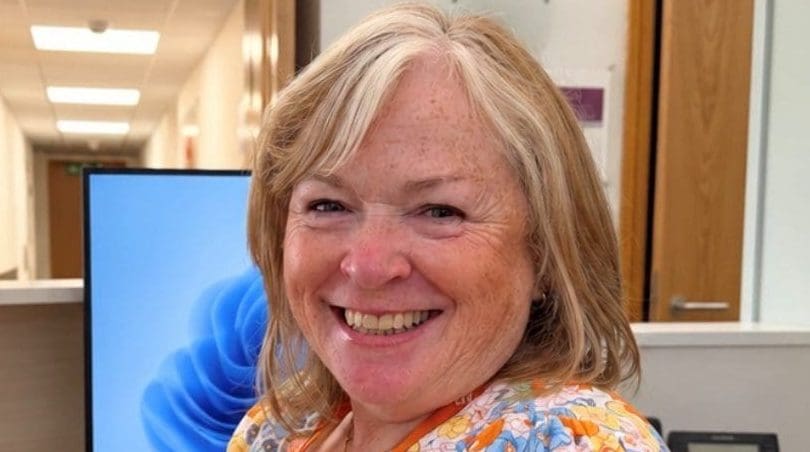
A wonderful welcome from a familiar face
“I just wanted to do something”: what Maeve sees from ellenor’s welcome desk
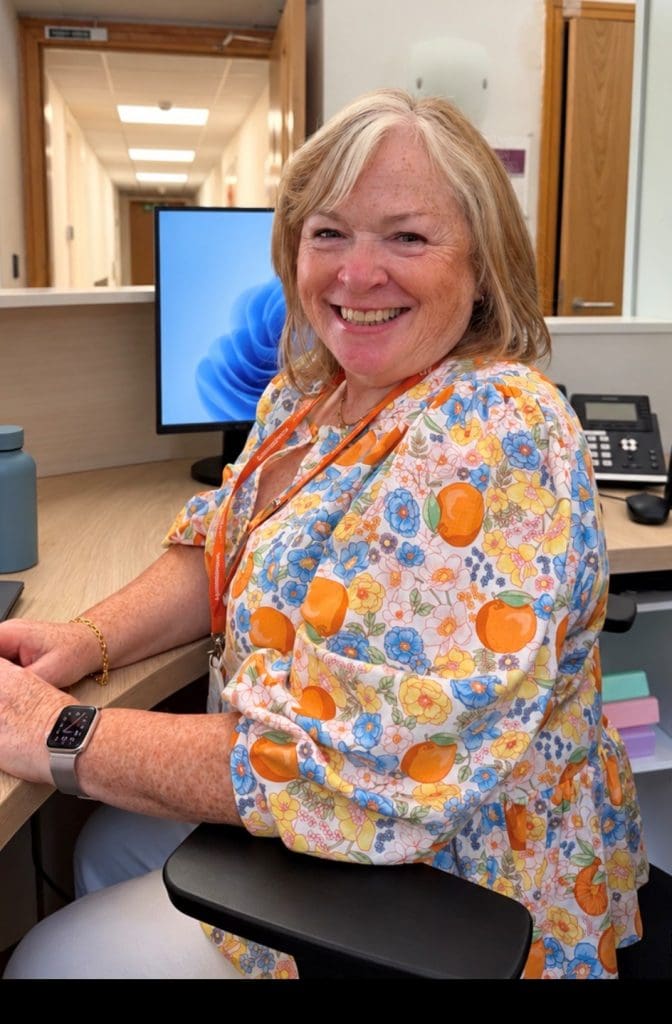
On Monday afternoons, Maeve Davies sits behind the host desk at ellenor.
People arrive at the hospice for all sorts of reasons. Some have been referred to ellenor for care. Some are visiting someone on the ward. Others have come for counselling or are walking into a hospice for the first time, not knowing what to expect.
Maeve has learned that sometimes people do not need an answer straight away. They just need someone to welcome them.
“I think everybody expects it to be a sombre, serious place,” she says. “And sometimes it has to be. But it’s also warm and welcoming.”
Maeve’s role is practical. She greets people, answers questions, takes donations and helps visitors find their way around. But there is another part of the job that cannot really be listed.
“I think lots of people just want to tell you what’s happened. It’s a way of coping, isn’t it?”
Maeve has been volunteering at ellenor for over two years. She lives in Meopham, where she has been part of the community for more than two decades. Before retiring, she worked in London, first in financial planning and later behind the scenes at John Lewis.
Her decision to volunteer at a hospice was personal.
Her sister died from cancer aged 59. She had been cared for by her local hospice, which helped her spend Christmas at home with her family. At around the same time, Maeve was diagnosed with breast cancer herself.
“It was a dreadful year,” she says.
When Maeve decided she wanted to do something, ellenor felt like the natural place to come.
“I just wanted to do something,” she says. “This was the nearest version of where my sister was.”
But from behind the host desk, Maeve has seen a side of hospice care that many people never see.
She still hears the same misconception from friends and people in the community: that a hospice is somewhere you go at the very end of your life.
“There is still a belief that you go to a hospice to die and yes, you could do, but not every time. It could be for other reasons.”
At the host desk, she sees the wider picture. She sees families arriving uncertain and sometimes frightened. She sees people returning after bereavement. She sees familiar faces coming back to the café.
One of them is a man whose wife was cared for by ellenor before she died. He took part in the Twilight Walk with his grandsons and still comes into the hospice café.
Maeve has seen what happens after someone dies, when the first rush of support begins to fade.
“Everybody gathers round for a while to support you but then, at the end of the day, you’re left to deal with it. And that’s the way life is sometimes.”
At ellenor, he has somewhere familiar to go. People know him and say hello. He can pop into the café, have a cup of tea and a chat. He feels comfortable there.
“The environment is familiar,” Maeve says. “He feels comfortable here.”
For Maeve, it is a reminder that the relationship with a hospice does not necessarily end when someone dies. The people left behind need somewhere to go, too.
It is easy to think of hospice care in terms of doctors, nurses and other professionals. But sometimes it is the smaller things that matter such as a familiar face, a cup of tea, somewhere to sit and talk. And behind all of it is the support that makes ellenor possible, from the people who give, fundraise, volunteer or simply help others understand what a hospice does.Maeve is not sentimental about volunteering. She enjoys it.
“I get something out of it,” she says. “I enjoy being here. I like the structure it gives my week as well, and I like the interaction with people.”
There is a common assumption that hospices are paid for by the NHS. In reality, NHS funding covers only part of the cost of providing hospice care, with the rest raised through fundraising, donations, retail, legacies and the support of the local community.
“If people understood more about how the funding works and that chasm that has to be filled with fundraising and donations and supporters, I think people would be more engaged and possibly more generous,” Maeve says.
That support comes from all over the community. From the person receiving care, to the daughter sitting beside them, the husband learning to live after losing his wife, the volunteer greeting people at reception and the supporter who may never meet any of them but helps make the care possible.
They might take part in the Twilight Walk, make a regular donation, leave a gift in their will, buy something from an ellenor shop or simply tell a friend what they have learned about hospice care.
They may never meet one another. But they are connected by the place they are helping to keep here.
Maeve has a way of putting it.
“Use it or lose it,” she says. “Support it or lose it. Because if a hospice doesn’t get supported, it can’t survive.”
It is a blunt message, but Maeve is not saying it as a fundraising slogan. She has seen what that support makes possible. People arriving at the hospice for the first time, unsure what to expect. Families visiting someone on the ward. People coming for counselling. And the man whose wife was cared for by ellenor, who still comes back to the café because it is familiar and people know him.
For a supporter, those moments can feel a long way from a standing order, a sponsored walk or a purchase from an ellenor shop. But follow the thread and they are connected. Their support helps make sure ellenor is there when someone needs it.
For anyone thinking about volunteering, Maeve’s advice is simple.
“I think if you volunteer for ellenor, you will get more out of it than you put into it.”
Filter by: