{{ item.categories[0] }}

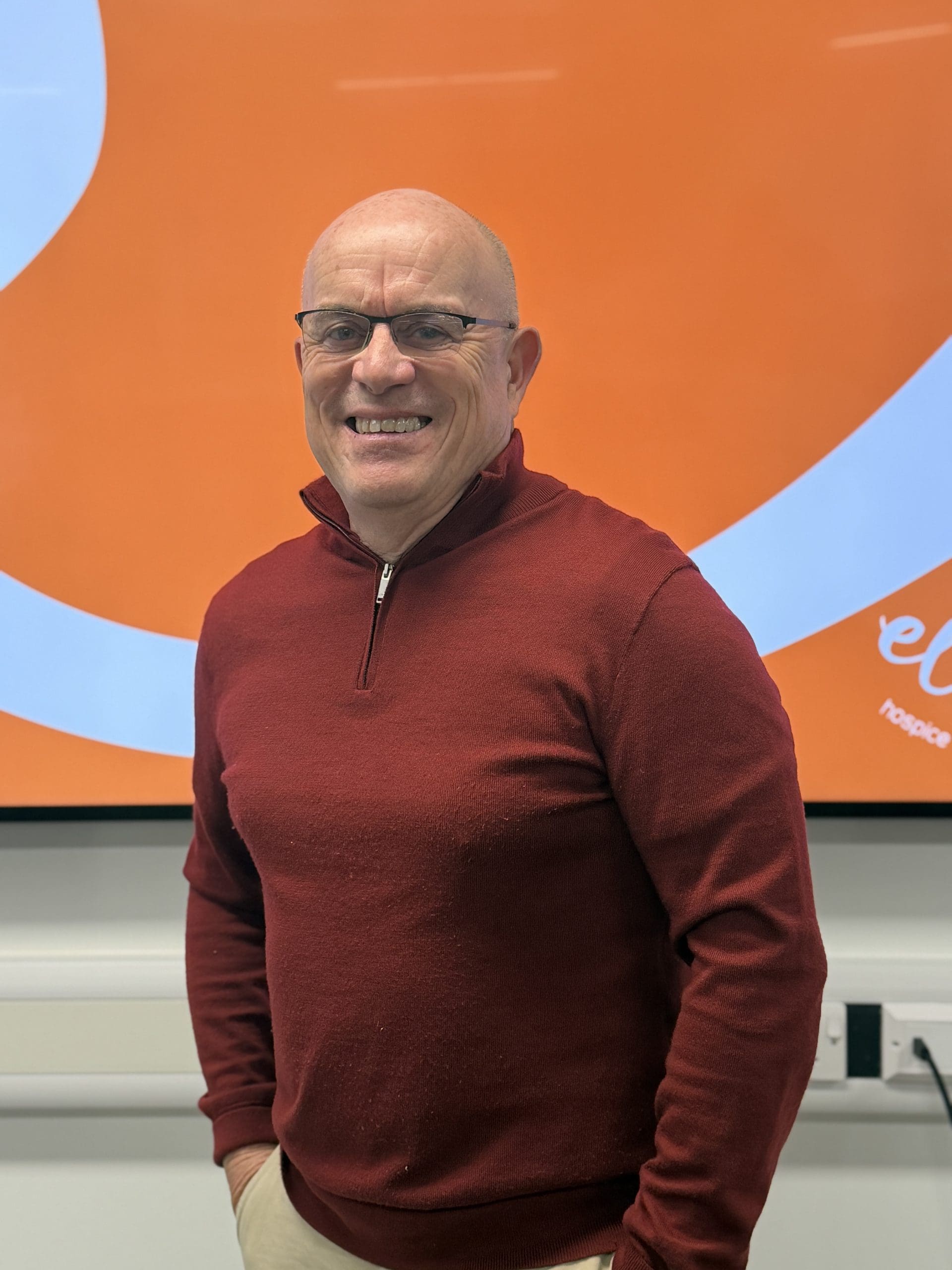
ellenor’s new chair Duncan Holt on discovering the reality of hospice care.
When Duncan Holt first heard about ellenor, it had nothing to do with hospice care.
“The only thing I really knew,” he says, “was that my daughter had once been to a dog show in the gardens about fifteen years before.”
Like many people in the community, Duncan thought he broadly understood what a hospice did. It was only when he became a trustee two and a half years ago that he began to see the full picture.
Now, just over a week into his new role as Chair of Trustees, he reflects on how quickly that understanding changed.
“You think you can put it in a little box,” he says. “You think you’ll give a certain number of hours and that will be that. But nine months to a year in, you’re completely in.”
Duncan has spent most of his life rooted in the local area. Born in Gravesend, with family connections across Meopham, Longfield and Greenhithe, he describes himself as “a pretty local sort of guy”. That local connection matters deeply in a role that is all about helping ensure ellenor remains strong for the communities it serves across North Kent and Bexley.
Before joining ellenor, Duncan spent most of his career in the City.
“I worked in the City from the age of twenty-one,” he says. “I was a foreign exchange dealer for an Australian bank and travelled extensively, working in New York, Singapore and New Zealand. I had a very lucky career in that respect.”
After stepping away from that world around eight or nine years ago, he moved into semi-retirement, running a small marketing company, becoming involved in property, and continuing governance work, including serving as a non-executive director of a pension fund.
It was through that governance experience that he was first approached about becoming a trustee at ellenor.
“At the time, it was literally just an invitation to talk about becoming a trustee,” he says. “I didn’t really know much about the hospice.”
What followed was a gradual but profound shift in understanding, not only of what hospice care is, but of the role a local hospice plays in the life of a community.
“I’d never heard the expression ‘good death’ before,” he says.
That phrase stayed with him, particularly as he began to understand the difference hospice care can make to patients and families at the most difficult time in their lives.
He is clear that one of the biggest misconceptions about hospice care is that it is only about the inpatient ward, or only about the very end of life.
“You look at the ward and there might be three, six or nine people there,” he says. “But that’s just not what hospice care is about. There’s so much else going on. There’s the home care, the therapies, the counselling.”
That wider picture is central to ellenor’s work. Most of its care takes place in the community, supporting people in their own homes, in care homes and through specialist therapies, counselling and family support. Across North Kent and Bexley, ellenor provides specialist palliative and end of life care from diagnosis onwards, helping people live as well as possible for as long as possible.
Another area that surprised Duncan was how hospice care is funded.
“I didn’t understand how much has to be raised to make hospice care happen,” he says. “It’s a really interesting dynamic of nursing and care, alongside sales and income generation. There aren’t many places where you see those two things together, but you do at a hospice.”
For someone who spent decades working in finance, the scale of that challenge stood out immediately. He says many people are surprised to learn how much a local hospice delivers, and how much of that depends on the support of the community.
“This hospice exists because the community believes in it,” he says.
As Chair of Trustees, Duncan’s role is not to run the hospice day to day. That responsibility sits with Chief Executive Jon Quinn and the Leadership Team. Instead, the board provides governance, accountability and strategic oversight, helping ensure the charity is well run, sustainable and able to deliver its mission.
“Our job is to make it as easy as possible for Jon Quinn and the Leadership Team to get the absolute maximum out of this hospice,” he says.
He is clear that the responsibilities of trustees and the executive team are distinct.
“Jon’s role is delivery on strategy,” he says. “Our role is governance.”
Trustees also carry legal responsibility for the organisation.
“We’re the ones that are ultimately responsible,” he says.
While the word governance can sound technical, Duncan believes it matters deeply to patients and families, even if they never use that language themselves.
“It’s critical because it’s where it starts,” he says. “Good governance supports good strategic direction, and that then supports delivery.”
In practical terms, that means helping ensure ellenor is safe, accountable, financially sound and strong enough to be there not only for families now, but for future generations too.
For Duncan, one of the most striking things about ellenor has been the commitment of the people who work there.
“In a lot of organisations, people walk out the door at five o’clock and they don’t think about work again until the next morning,” he says. “That definitely isn’t the case here.
“Everyone really deeply cares. Whether they’re on the ward, in income generation, in the kitchen or in the laundry, people care about their hospice.”
He says that commitment is visible across the organisation, and reflects the skill, resilience and professionalism of the people who work and volunteer there every day.
As he steps into the role of Chair, Duncan says one of his priorities is to help build trust, strengthen communication and make sure trustees are visible, engaged and clear about their role.
“I want people to know what we’re doing and what our part is,” he says. “I want to build a lot of trust over the next six months to a year.”
He also wants to ensure the board continues to evolve in a way that supports the future of the charity, while recognising the strength that is already there.
“We’ve got an awful lot to do,” he says. “But if, when I step down one day, I’ve left it with better processes than when I started, that would be a good outcome.”
At the heart of that ambition is a simple belief: that hospice care matters, that community support matters, and that ellenor’s future depends on continuing to bring those two things together.
For Duncan, that is what makes the role so meaningful.
Like so many people who come to understand hospice care more closely, he may have started by thinking it was something he could keep in a box.
He knows now that it is much bigger than that.
Filter by: