{{ item.categories[0] }}


As Dr Mehak Moid settles into the chair opposite mine, I’m struck by her calming presence.
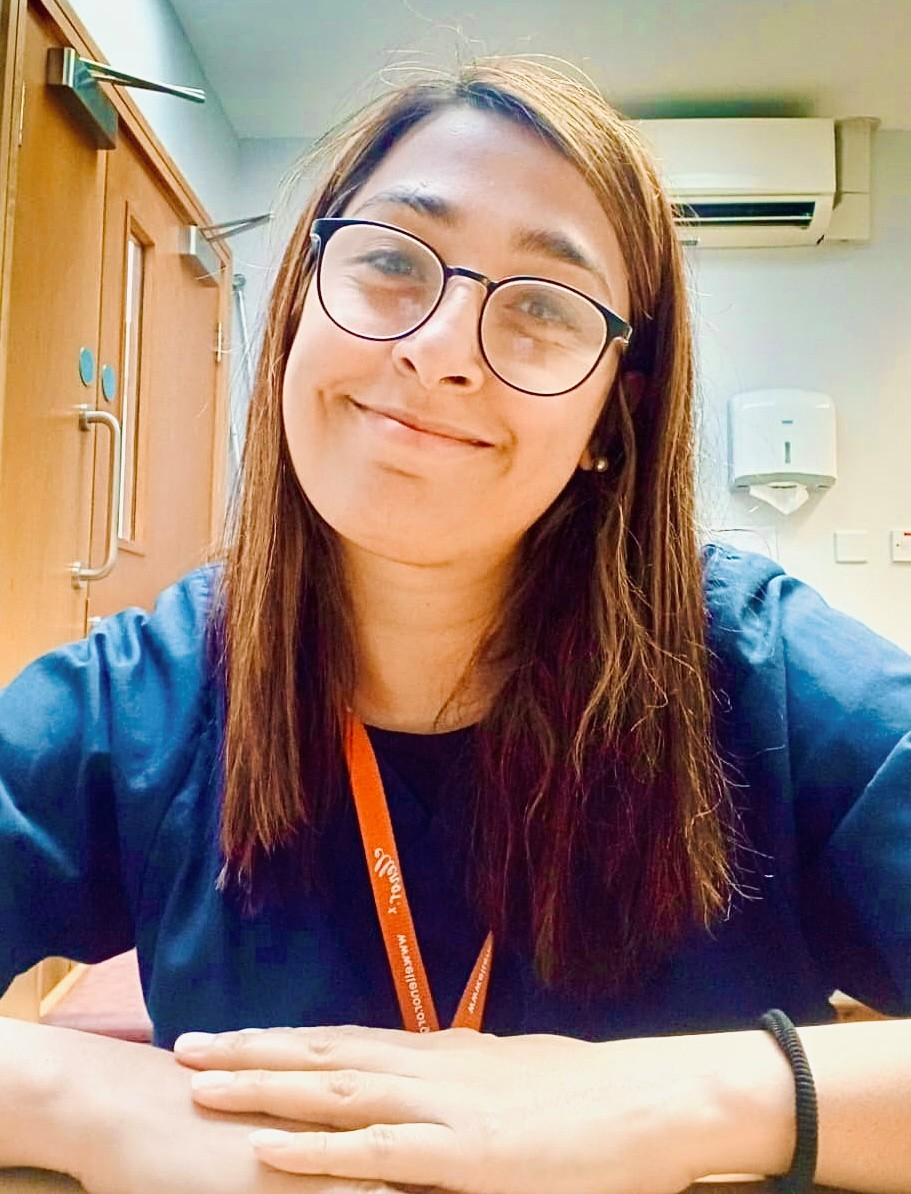
The 30-year-old clinician hasn’t yet said more than a word – but the natural warmth and friendliness she exudes across the table lets me know it’s going to be a good interview.
Dr Moid has been at ellenor – a hospice charity providing care and support for patients with life-limiting illnesses in Kent and Bexley – for six months. Based solely on the inpatient ward at ellenor’s Northfleet-based hospice, Mehak is a Specialty Doctor: lending her expertise in palliative and end-of-life care to manage her patients’ pain, treat their symptoms, and help them die with dignity, surrounded by their loved ones.
It seems fitting that the approachable, kind woman in front of me would choose a path dedicated to supporting others – and, Mehak tells me, she’s known she wanted to be a doctor from a young age.
But that’s a story that starts 21 years ago, in a city almost 8,000 km from Gravesend – and one that Mehak almost didn’t escape from with her life.
Mehak was nine as she ran, carefree, through the streets of her native Karachi: Pakistan’s largest city, and the 12th biggest in the world. All of a sudden, a car veered out of the street’s traffic-clogged thoroughfare and struck her: breaking Mehak’s foot in several places, and requiring 12 operations.
It would be a long way back to recovery. But ironically, it would also be the catalysing event for Mehak’s career in medicine. Inspired by the caring nature and soothing bedside manner of the doctors looking after her, Mehak resolved to follow in their footsteps.
It was a dream that would eventually see her through five years of medical school in Pakistan, before a further year on placement in a hospital. It was at this stage that Mehak fell in love with palliative care: a ‘holistic’ form of medicine that aims to treat not only the patient’s physical needs, but their emotional, social, and psychological needs, too. Palliative care’s key ethos – an emphasis on the patient’s quality, rather than quantity, of life – appealed to Mehak; as did the discipline’s focus on keeping the patient calm, comfortable, and pain-free, and providing support for their loved ones.
“I’ve always wanted to help people; to make a difference.”
So, Mehak knew what she wanted to do. But where she would do it was another question. And soon, the Karachi-born doctor decided it was time for a change – to pursue her passion for palliation in a new environment that would put her skills to the test, and offer the perfect platform for her aspirations…
…England.
The transition wasn’t easy. It involved layers of gruelling practical and theory-based assessments to test not only Mehak’s clinical skills, but her ability to speak English. And, naturally, a lot of paperwork.
But two years later, Mehak was in the country – and on the lookout for the right opportunity.
Here’s where Mehak’s and ellenor’s paths cross: a moment 21 years in the making, and that – six months down the line – would lead Mehak to be sharing her story with me here in a meeting room at ellenor’s Coldharbour Road-based hospice. There’s no intricate narrative around how she found us: she simply searched Google for the best hospices near her Dartford home, and ellenor was top of the list.
As Mehak talks, I realise why I felt such a strong, almost instant connection with her – she reminds me of my daughter, who is a similar age and also studying medicine. In fact, being in this line of work I often find myself wondering whether hospice care is something my daughter might end up being interested in. But of course, hospice care isn’t easy. So, returning Mehak’s smile, I ask: what’s it like dealing with the challenges of hospice care at such a young age?
Mehak smiles ruefully. “It’s hard,” she says simply, before describing a recent example of a woman she provided end-of-life care for on the ward at ellenor. The patient was only 37. Mehak also describes the need to have difficult conversations with patients, and their families – in telling a person that they don’t have long to live, for instance, or informing a wife of her husband’s prognosis.
Doctors are, after all, still human. They have emotions. Death affects them – especially when it comes calling far, far sooner than it should.
But within the folds of that tragedy, Mehak explains, there’s a beautiful gem of hope – the fresh appreciation for life and mortality this work provides.
“When you’re young, you don’t think about death that often. You think about your career; your goals; how much money you have, or where you’d like to travel to next. In other words, you’re thinking about your future – but what about your present? So sometimes, working in this field gives you a check.
“Is it really worth it, worrying about and pursuing all those little things that preoccupy us? Or should we just be seizing the day?”
I’m left a little speechless. Everything Mehak is saying makes sense. I think back to the car that hit Mehak when she was nine – and the long, improbable sequence of events that had to happen for her to be sitting in Northfleet talking to me – and think about her lifelong desire to ‘make a difference’.
Which leads me to my final question. Mehak – why do you do it?
“Making a difference to someone’s life who is young and healthy is one thing,” she replies. “But making a difference to the life of a person who is dying – to be able to give them dignity and comfort through the right care and support – that’s altogether different. Seeing families make the last memories of their loved ones in a positive light – because they know their family member is dying comfortably and in peace under the care of ellenor in the hospice or at home, rather than in pain and distress – makes it all worthwhile.”
I pause, then reach over to my phone to stop recording the conversation. I think, briefly, of the time – hopefully many, many years in the future – of when I might need the services of a hospice. And, smiling back at Mehak, I can’t help but think that, when that day comes, this is the kind of compassionate, empathetic face I’d want standing over my bed.
But such musings on mortality can wait for another day.
The two of us stand up, stretch, then head out for a coffee.
Filter by: